
agro-industry · cold room
Solar cold room in Senegal: technology, cost and ROI for agro-industry
Powering a 100 % solar cold room is possible and profitable. The real cost, technology and payback of an actual industrial installation in Sandiara.
The Senegalese cold chain challenge
In Senegal, losing a cold room for 6 hours is enough to spoil an entire shipment — fish, meat, vegetables, dairy. Yet the Senelec grid still has frequent outages, especially in rural and peri-urban areas. Many operators back up with a diesel generator, but fuel costs can reach USD 650 to 2,500/month in continuous operation. Hybrid solar solves both problems: it secures the cold chain and eliminates the energy bill.
A real installation: Sandiara, 35.5 kWc + 60 kWh
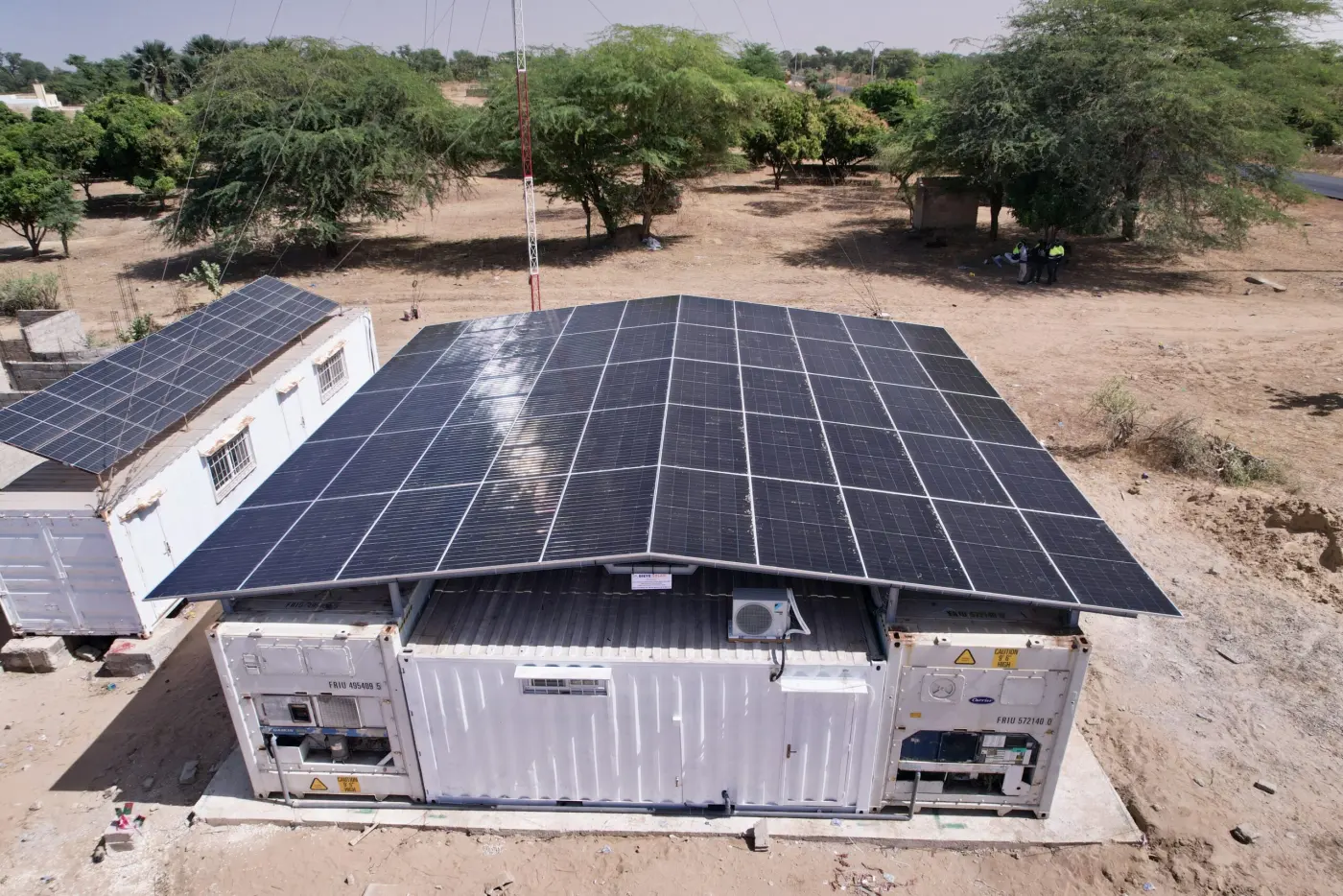
In 2026, DSG equipped an agri-food processing unit in Sandiara with two 40-foot refrigerated containers. The need: 24/7 cold, even under grid outage. The solution: a 35.5 kWc hybrid plant on a steel canopy built by DSG's BTP crews, coupled with 60 kWh of lithium storage and hybrid inverters. The site has run uninterrupted since commissioning. Solar production covers the day, batteries hold through the night, and Senelec outages no longer matter.
How we size it
For a cold room we start from installed refrigeration power (in kW cold) and compressor duty cycle. A positive cold room (0-5 °C) of 20 m³ consumes on average 3-5 kWh/day per m³, i.e. 60-100 kWh/day. A negative room (-18 °C) consumes 2-3 times more. We size the solar field for 80-90 % of annual consumption in self-consumption, and batteries for 10-15 hours of backup (a night of outage without breaking the cold chain).
Typical project cost
Ranges observed on DSG projects:
- Positive cold room 20 m³ (restaurant, butcher): USD 25,000 to 37,000 all-in.
- 40 m³ cold room for a processing unit: USD 42,000 to 58,000.
- Two 40-foot containers (Sandiara, 35.5 kWc + 60 kWh + BTP canopy): USD 70,000 to 92,000.
- Industrial site >100 m³ of cold room: from USD 117,000.
Payback: 3-5 years depending on use profile
For an operator paying USD 800/month in Senelec + diesel, savings are immediate and total after installation. At USD 10,000/year, a USD 50,000 installation is paid off in 5 years. Beyond that, production is nearly free for 10-15 more years. For a site with frequent outages, ROI is even shorter because you add the value of spared goods.
Beyond cost: cold chain quality
An often-underestimated benefit: hybrid solar provides temperature stability no diesel generator can match. No cold start, no brief interruption, no temperature spike that degrades goods. For export (shrimp, mangoes, smoked fish), this stability eases sanitary certification and opens premium markets.
DSG, a single interlocutor for the whole project
A solar cold room combines 5 trades: energy study, solar panels, lithium storage, industrial electricity and BTP (canopy, slab, technical room). DSG brings these trades together in one team — that's the principle behind the Sandiara project. One contract, one interlocutor, one site.
Frequently asked questions
- Can you power a cold room 100 % on solar in Senegal?
- Yes, if you size battery storage correctly (10-15 hours of autonomy) and pick modern variable-speed compressors that smooth consumption. DSG's Sandiara 2026 installation runs this way uninterrupted.
- How much does a solar cold room cost in Senegal?
- A small 20 m³ positive cold room complete (cold + solar + batteries) costs USD 25,000-37,000. An industrial unit with two 40-foot containers is USD 70,000-92,000 all-in. ROI is 3-5 years depending on use.
- What autonomy should you plan for grid outages?
- For a critical cold room we size 10-15 hours of battery backup, more than a full night. Beyond that, next-day solar production takes over. That covers 99 % of outages observed in Senegal.
Need a free study?
Let's talk about your project.
Free study within 72 hours, detailed line-by-line quote, on-site visit by our teams.