
agriculture · pumping
Agricultural solar pumping in Senegal: sizing, pump selection, cost per hectare
Practical guide for farmers and market gardeners: required water volume, pump type, solar power, cost per m³ and per hectare.
Why solar pumping is a no-brainer in Senegal
For a market gardener in Keur Madaro, a farmer in Kaolack or a stock breeder in Casamance, diesel pumping eats 20-40 % of operating costs: 600-900 L of diesel per month depending on acreage, i.e. USD 650 to 1,200. Solar pumping wipes out this spending. Once installed, it only runs on sunlight — free and abundant in Senegal (5.5 kWh/m²/day on average). Solar pumping projects DSG delivers in the Thiès region have payback periods of 2 to 4 years, among the shortest of all solar applications.
How much water does solar pumping deliver?
Production depends on three parameters: installed solar power, pumping depth and pump type. Useful Senegalese benchmarks:
- 1.5 kW pump at 30 m depth: 40-60 m³/day. Enough for 1-1.5 hectares of drip-irrigated market gardening.
- 2.2 kW pump at 40 m (Keur Madaro type): 60-100 m³/day. Covers 2-3 hectares or a 100 m³ basin.
- 4 kW pump at 60 m: 100-160 m³/day. Small farm of 3-5 hectares.
- 7.5 kW pump at 80 m: 200-300 m³/day. Large farm, livestock, village borehole.
The 3 types of solar pump
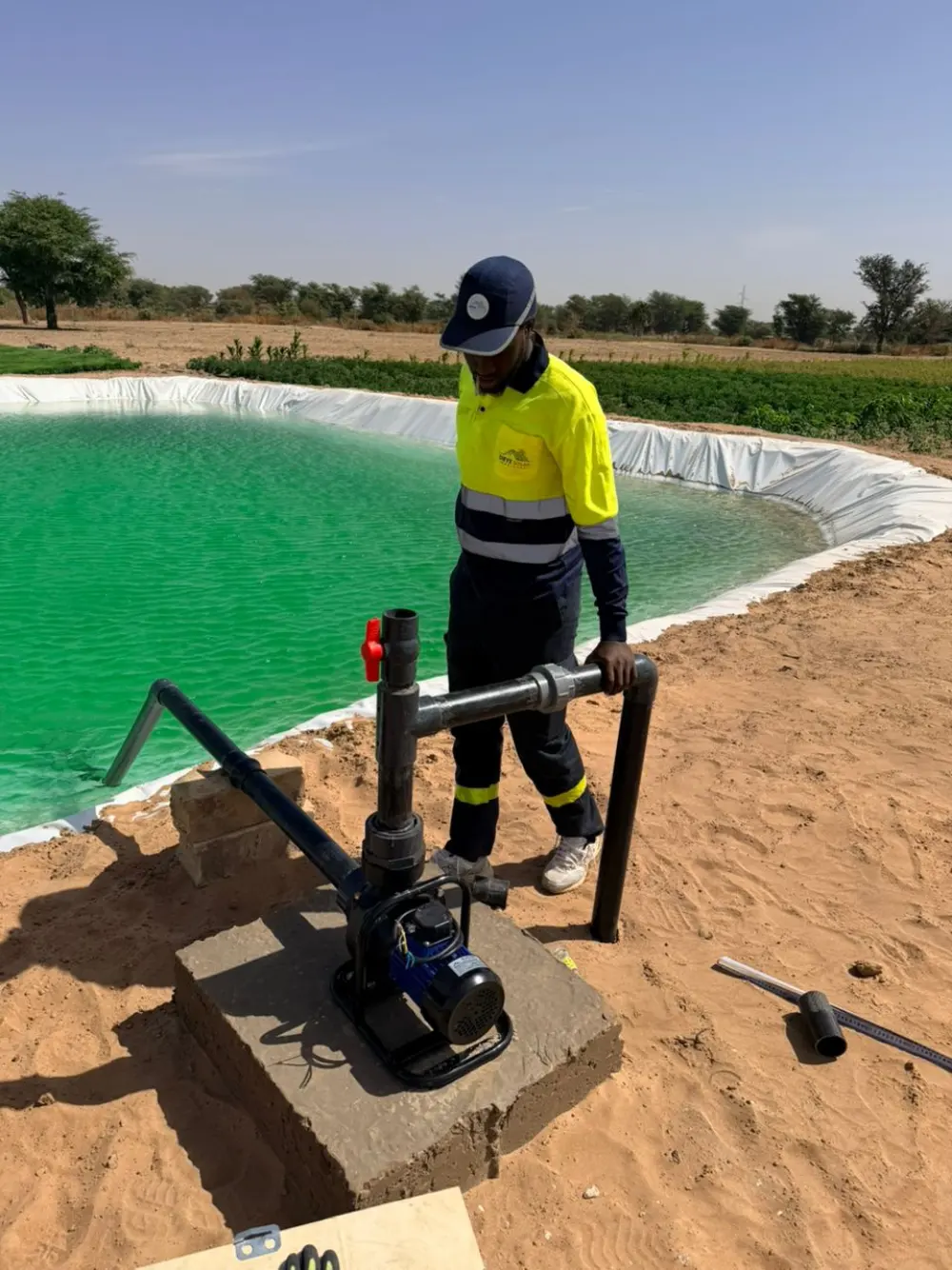
Submersible centrifugal is the most common in Senegal for boreholes of 20-100 m: reliable, simple, low maintenance. Surface pump is for open wells and basins up to 7 m deep: easy install, low price. Diaphragm pump (or Archimedes screw) is useful for low-flow boreholes and sand-laden water: pricier but more tolerant of difficult conditions.
Sizing: the DSG method
We always start from daily water need per crop:
- Drip-irrigated market gardening: 30-50 m³/ha/day
- Mature orchard: 20-40 m³/ha/day
- Sprinkler-irrigated fodder: 50-80 m³/ha/day
- Watering 100 cattle: 5-8 m³/day
Cost per m³ and per hectare
A full system (borehole + pump + drive + panels + structure) costs between USD 5,000 and 25,000 depending on power. Over 15-year lifetime, cost per m³ of water drops to USD 0.02 to 0.05, versus USD 0.25-0.50/m³ with a diesel generator (fuel + maintenance + wear). Per irrigated hectare, solar investment sits between USD 2,500 and 7,000, amortised in 2-4 seasons.
Water storage or electric storage?
For pumping, we almost always recommend storing water rather than electricity: a 20 m³ tank costs 10 times less than a battery bank with equivalent useful energy. Pump during the day, store in a basin or water tower, distribute on demand. This is the Keur Madaro approach: pump + basin, zero batteries.
Maintenance: a few hours a year
A well-installed solar pumping system needs very little maintenance: quarterly panel cleaning, annual drive and protection check, biennial pump control. DSG offers pumping maintenance contracts from USD 150/year, signed visits and reports included.
Frequently asked questions
- What solar pump power do you need for 1 hectare?
- For 1 hectare of drip-irrigated market gardening, count 30-50 m³/day, i.e. a 1.5-2.2 kW solar pump at 30-40 m depth, with a 2-3 kWc solar field. For sprinkler or orchard, adjust to the crop water need.
- How much does solar pumping cost in Senegal?
- A complete system (borehole + pump + drive + panels + structure) costs between USD 5,000 and 25,000 depending on power and depth. A 2.2 kW system like Keur Madaro runs about USD 8,500 to 12,000 all-in.
- Do you need batteries for solar pumping?
- No, it is counterproductive. Storing water in a basin or water tower is 10 times cheaper than storing electricity in batteries. Pump during the day, distribute on demand.
- How long does a solar pump last?
- A quality submersible pump (Lorentz, Grundfos SQF, Mono) lasts 10-15 years in agricultural use with annual maintenance. Panels exceed 20 years. The drive is replaced once over the lifetime.
Need a free study?
Let's talk about your project.
Free study within 72 hours, detailed line-by-line quote, on-site visit by our teams.