
equipment · batteries
Lithium vs lead-acid batteries, Deye vs Victron inverters: which gear for your solar installation?
The real comparison between technologies and brands installed in Senegal: prices, lifespan, performance, use cases. No advertising.
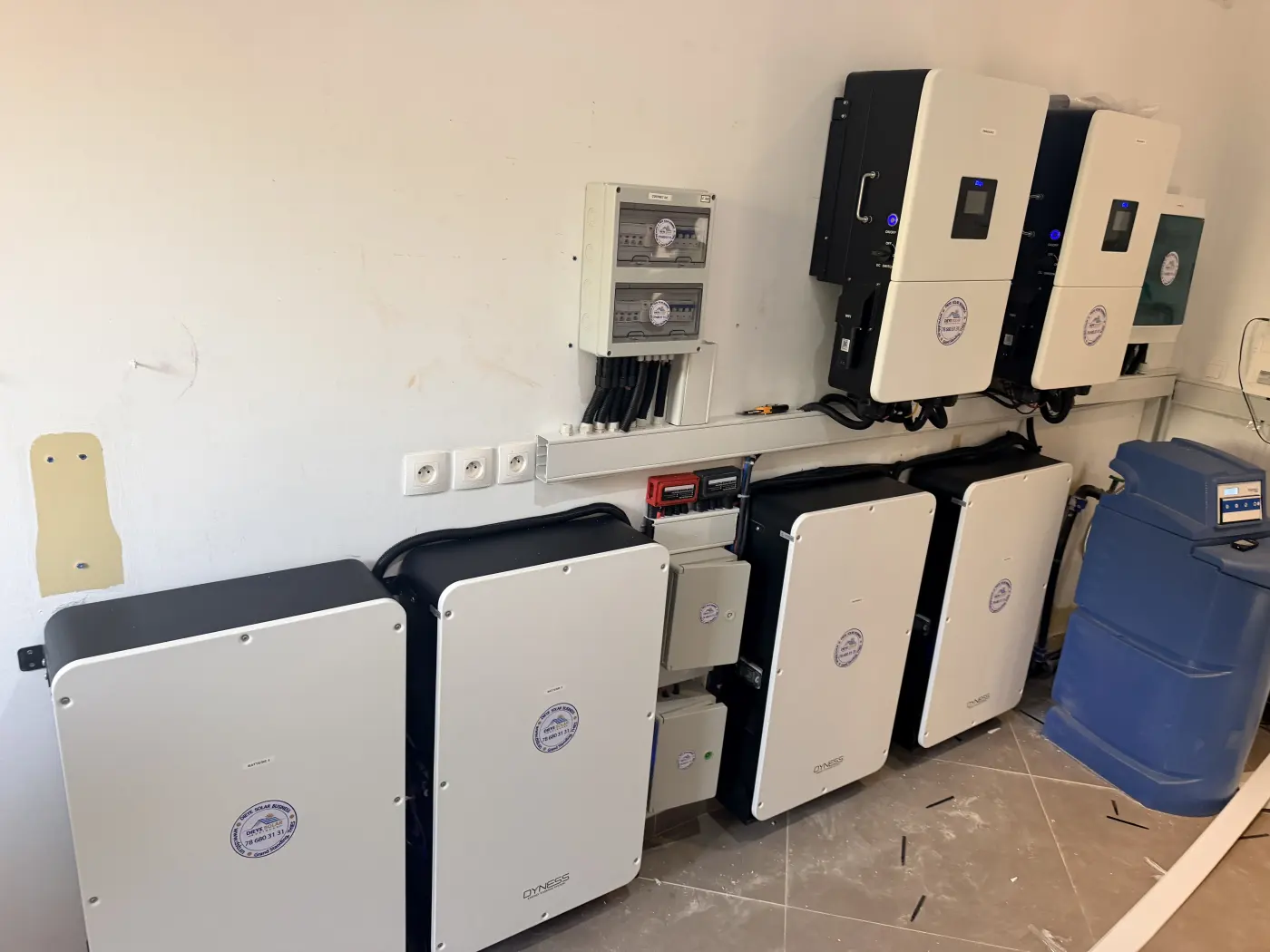
Lithium or lead: the decision that changes everything
Between a USD 700 lead-acid battery and a USD 1,550 LiFePO4 lithium battery of equivalent capacity, the choice looks obvious. It isn't. A lead-acid battery lasts 400 to 800 cycles, i.e. 2-4 years in daily use. A LiFePO4 lithium battery lasts 3,000 to 6,000 cycles, i.e. 10-15 years. Over 10 years, you replace a lead battery 3-4 times, versus zero for lithium. Total cost becomes equivalent — and lithium wins on reliability, depth of discharge (90 % vs 50 %) and footprint.
Dyness, Pylontech, GSB, BYD: which lithium brand?
Brands installed in Senegal fall into three tiers. Premium: BYD, Pylontech, Huawei LUNA2000 — reliable, well supported, global SAV, 10-year warranty. Balanced: Dyness, GSB — great price/quality, positive 3-year field feedback from DSG installs. Entry-level: generic Chinese brands — avoid except for non-critical uses. Our experience: Dyness 10 kWh for villas (good balance), BYD for critical sites (cold rooms, data), GSB for secondary sites.
Deye vs Huawei vs Sungrow vs Victron: the inverter that makes the difference
A solar inverter drives the whole installation: grid/battery switchover, charge regulation, protection. A bad brand ruins a good panel. Deye dominates the Senegalese residential market: hybrid, single or three-phase, 3-20 kW, excellent price/quality, clear interface, local SAV. Huawei shines on commercial and industrial sites: SUN2000 string inverters, native cloud supervision. Sungrow is the industrial pick: our 7 × 115 kW inverters on the 1 MWc Sandiara plant run without fault. Victron remains the gold standard for off-grid and marine: pricey but ultra-reliable and modular.
Panels: Canadian Solar, JA Solar, Longi, Felicity
The three global giants — Canadian Solar, JA Solar, Longi — are widely distributed in Senegal. They are safe choices, warranted 12 years product and 25 years linear production. Monocrystalline PERC and TOPCon dominate, with 20-22 % efficiency. Bifacial panels (Canadian Solar 630 W for example) add 5-15 % production thanks to the rear face catching reflected light — useful on canopies or ground mounts. Felicity Solar is a reliable African brand well suited to local conditions (heat, dust). Avoid unknown brands with opaque warranties: 10-year reliability can't be verified at purchase.
The right reflex: match gear to project
There is no absolute best brand. At DSG, we combine: Deye + Dyness + Canadian Solar for villas (90 % of cases), Huawei + BYD + Longi for industrial sites, Sungrow + bifacial Felicity for large injection plants. The choice depends on 4 criteria: site criticality, budget, SAV availability, future integration (planned extension, supervision).
Warranties: what to check
- Panels: 12 years product, 25 years linear production (85 % power guaranteed at 25 years).
- Hybrid inverters: 5 years minimum, extensible to 10 years.
- Lithium batteries: 10 years or 6,000 cycles, whichever comes first.
- DSG installation: 2 years labour, wear parts (cables, protections) covered.
Frequently asked questions
- How long does a lithium solar battery last?
- A quality LiFePO4 lithium battery (Dyness, BYD, Pylontech) lasts between 10 and 15 years, i.e. 3,000 to 6,000 charge/discharge cycles. It accepts deep discharges (up to 90 %) without damage, unlike lead-acid (50 % maximum).
- What is the best solar inverter in Senegal?
- There is no universal best. Residential: Deye (hybrid, 3-12 kW, excellent value). Industrial: Sungrow or Huawei. Critical off-grid: Victron. Each brand has its strengths.
- Why choose lithium over lead-acid?
- Lithium lasts 4-10 times longer, supports deep discharges (90 % vs 50 %), takes 3-4 times less space and accepts higher charge currents. Over 10 years its total cost becomes lower than lead.
- What warranty should you require for a solar installation?
- Require 12 years product and 25 years linear production on panels, 5-10 years on the inverter, 10 years on lithium batteries, and 2 years minimum on labour. Serial numbers must appear on the commissioning report.
Need a free study?
Let's talk about your project.
Free study within 72 hours, detailed line-by-line quote, on-site visit by our teams.